建国
What each character carries 逐字小传
Not a dictionary entry: what the character has meant in Chinese names, with the original line it comes from. Every quotation below is matched character-for-character against a versioned corpus shipped with this site. Where a page names a character's origin, that line is our own paraphrase of the standard dictionaries — it is not a quotation, and it carries no book title for that reason.
王曰叔父,建尔元子,俾侯于鲁。
The king said: Uncle, establish your eldest son, and make him lord of Lu.
合百草兮实庭,建芳馨兮庑门。
Gather a hundred herbs to fill the courtyard; set up fragrance at the side doors.
Making something stand, rather than making more of it.
「建」是让人或事「立得住」,不是「造得多」。
能以礼让为国乎?
Can a state be run by courtesy and yielding?
Scale of concern, not a rank.
「国」在名字里是格局,不是官职。
How it sounds 怎么念
Mandarin is tonal: the same letters said on a different pitch are a different word. The line below is the pitch you actually travel while saying the name.
- Every syllable has a close English equivalent — nothing here is hard to say.
Is it a real name? 有多真
We checked it against a corpus of 1,142,000 real Chinese names — this is not a combination invented for the page.
How this score is built 评分怎么来的
Five dimensions, each scored independently. Every bar below is a real computed value — the same rule set that generated the candidate list, not a separate "premium" model.
How people will actually call you 别人会怎么叫你
A Chinese name is almost never used in full. In daily life it gets a prefix, a suffix, or is cut to the given name alone — and which one you get tells you how close the person thinks they are to you.
Patterns, not rules: what you are called depends on your age, the relationship, and the region. In the south you will also hear 阿 + given name between friends.
FAQ 常见问题
- How do I say 建国?
- jiàn guó. Tones: jiàn falling, guó rising.
- What does it mean?
- 建 — To establish and achieve; 国 — Country and commonwealth — breadth of mind and responsibility
- Is it a real, usable name?
- The pair "国" appears in 238 of 1,142,000 real Chinese names.
to establish · the state — taken as one scene rather than three separate definitions.
Save it to your phone 保存到本地
Ten layouts, one set of facts — the name, how it is pronounced, what each character means, the score and the five elements. Pick a style, then save it at full size. Real type, not an image model: the name can never be misspelt.
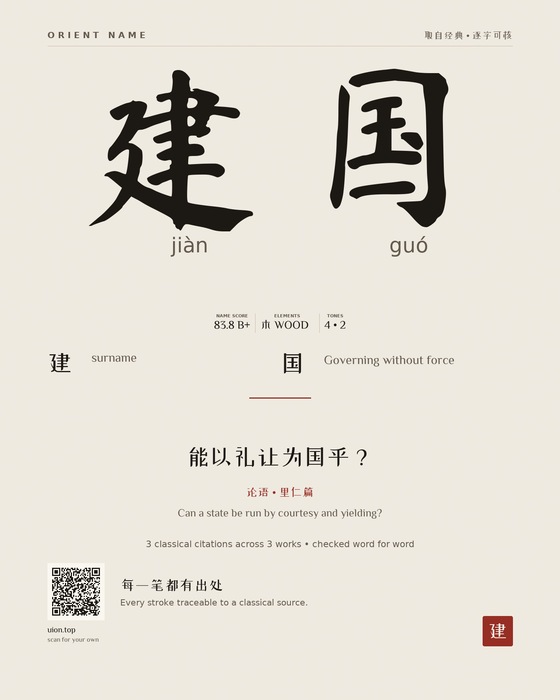


No account, no payment, no watermark. Type a name and you get the characters, the sound, and where each character comes from.
Make your own Chinese name →